
Copland & Twain - A Theatrical Concert
Wednesday, June 25, 2026
7:00 PM | Open Jar Studios
Ken-David Masur, conductor
Bill Barclay, writer and director
Carson Elrod, actor
Caleb Mayo, actor
Chloe McFarlane, actor
Maurice Emmanuel Parent, actor
Robert Walsh, actor
Run time: 85 minutes (no Intermission)
Selections from:
Music for Movies (1942) by Aaron Copland (b.1900-1990)
Music for Theater (1925)
Prologue
Sunday Traffic
Barley Wagons
Dance
Burlesque
Threshing Machines
Interlude
The Story of Grover’s Corners
New England Countryside
Epilogue
Star-Spangled Banner (1773) by John Stafford Smith (1750-1836)
arr. by Paul Lavender (2007)
Lyrics by Francis Scott Key
The Promise of Living (1952-4) by Copland
Festival Chamber Orchestra
Violin I | Jonathan Ong, Yuyu Ikeda, Reuben Kebede
Violin II | Dorothy Ro, Tiani Butts, Carlos Rafael Martínez Arroyo, Magdalena Masur
Viola | Abigail Rojansky, Marcus Stevenson
Cello | Jonathan Dormand, Pedro Sanchez
Bass | Bennett Norris
Flute | Catherine Boyack
Oboe | Amanda Hardy
Clarinet | Paul Wonjin Cho
Bassoon | Hannah Dickerson
Horn | Stephanie Fritz Ferguson
Trumpet | Olivia Pidi Weiss, Rebecca Steinberg
Trombone | Joseph Huggins
Percussion | Oliver Xu
Piano | Dimitri Dover
Costume Designer | Arthur Oliver
Projection Designer | Katy Tucker
Lighting Technician | Ian Clark
Wardrobe Manager | Jessica Zindren
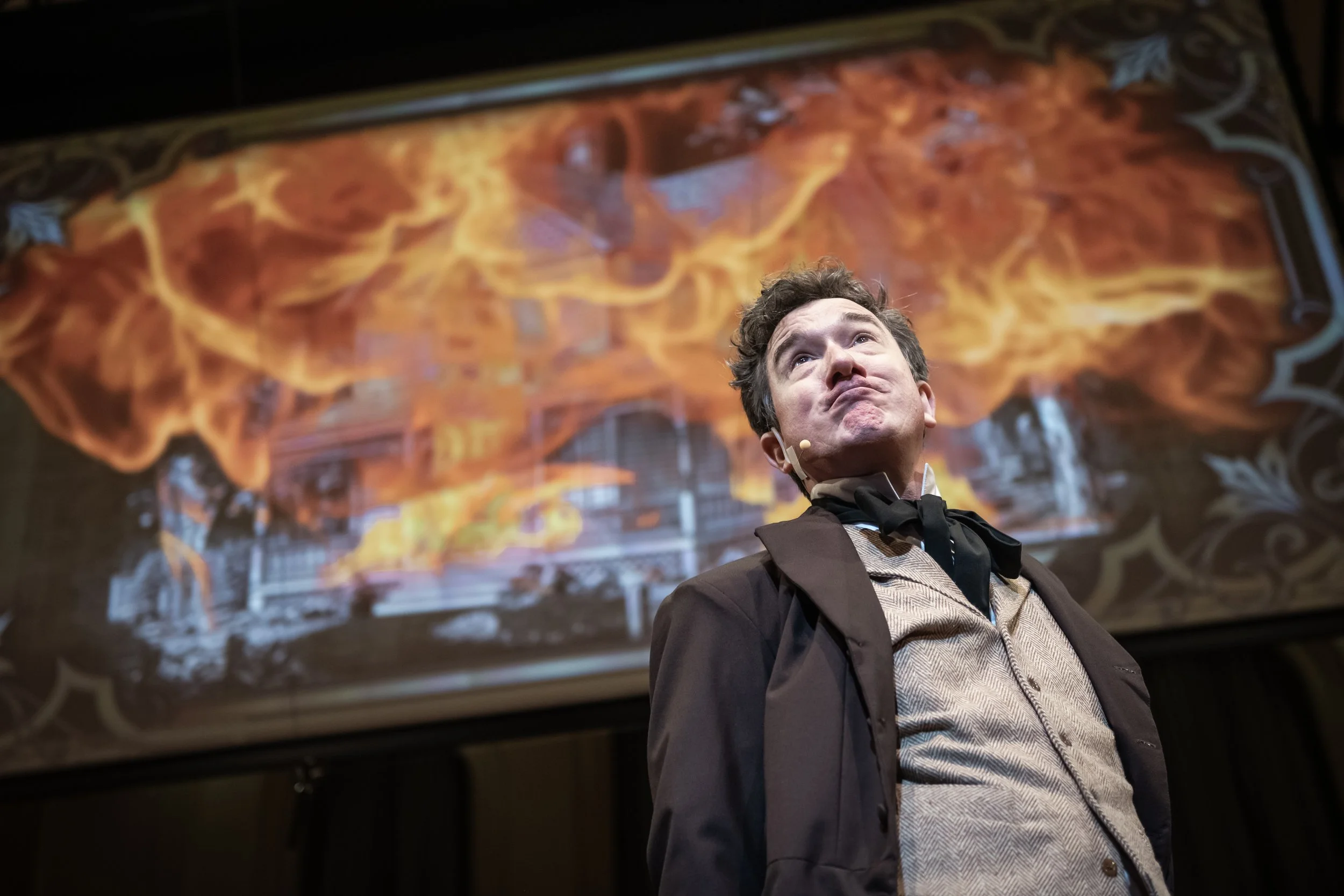
Projections from the America of Twain’s time, Copland’s time, and our own time, oscillating between stock imagery and animation, noting the provenance of the speeches and musical selections.
With thanks to Lewis Steinberg, we dedicate this evening in memory of Margery Steinberg, a stalwart patron of the arts who, along with Lew, became an integral part of our Festival family.
Reception to follow curated by Niederegger and Brotherhood Winery
With gratitude to the patrons & partners whose generosity has made this evening possible:
Lewis Steinberg
Margie & Everett Jassy
Dimitri Dover, Marion Lei Artist
Amanda Hardy, Lewis Steinberg Artist
Ivalas Quartet, Newbower Family Ensemble
Angela Lee, Le Fonds Pierre Jetée Artist
Open Jar Studios
Boylan Bottling
Brotherhood Winery
Carl Brandt
Centanni Percussion
Concert Theatre Works
Milwaukee Symphony Orchestra
National Endowment for the Arts
Niederegger
Radeberger Gruppe USA
Sennheiser
Steinway & Sons
Tarisio Fine Instruments
WQXR
Program Note
This program began by imagining how to publicly go about celebrating America’s 250th anniversary. How could this event serve such a polarized time in our history? I have always been moved by some of the traditional American tunes and hymns, but the state of our country called for something else, something I couldn’t quite identify at first.
I now realize that for some reason or other, I wanted to laugh. I wanted to release energy, not summon it. I wanted the community of joy, not the burden of politics. Yet it seemed that avoiding politics entirely was ignoring the elephant in the room.
A chamber audience today may be one of the last public spaces of American life that is truly politically heterogeneous. Is there a way we can laugh about our state of the nation without excluding people?
Today, Mark Twain seems as mainstream as apple pie, but during most of his life he lived the life of a tramp. Both a free-wheeling populist and a cunning intellectual, his brand of satire made him the first true American celebrity. He also left behind a voluminous body of largely forgotten work, writing every week of his adult life.
I took the opportunity of this anniversary to read some 2,000 pages of apocryphal speeches, articles, toasts, diary entries, and humorist essays I had never heard of before.
I wanted to look beyond the author of Huckleberry Finn and summon his faith in America from beneath the quips. The richness of this corpus, and its resemblance to the ills that still plague us today, is simply uncanny.
Aaron Copland is often called The Dean of American Music, and it’s not hard to understand why. His long life (1900-1990) witnessed several profound changes in American identity. Yet however closely we associate him with the establishment in retrospect, his actual lived experience — like Twain's — ran largely counter to that image. He was hauled before the House Un-American Activities Committee in 1953 as a suspected communist. He was blacklisted for is leftist associations and in other chapters of his life, marginalized for his homosexuality. His musical pivots away from the tonalism that made him famous and into the serialism of Arnold Schoenberg further cemented his outsider persona during his lifetime.
Today we present two distinctively American artists, mutually holding up core pillars of our identity, who need to be unpolished before authenticated. Their bodies of work cry out for a robust re-examination, and what else is an anniversary for? I take two of Copland’s lesser-known suites, Music for Movies, and Music for the Theatre, and restore them to their incidental roots, while sharing with you some of the gems collected from dozens of Twain’s most colorful passages that history has forgotten. It is a theatrical concert that I deeply believe both men would have loved.
-Bill Barclay, writer and director of Copland & Twain